Sleeping Next to a J6’er in the Ozarks
A dispatch from a campground in the Arkansas Ozarks—one neighbor, one night, and his answer to everything. Also, risking death via a nap.
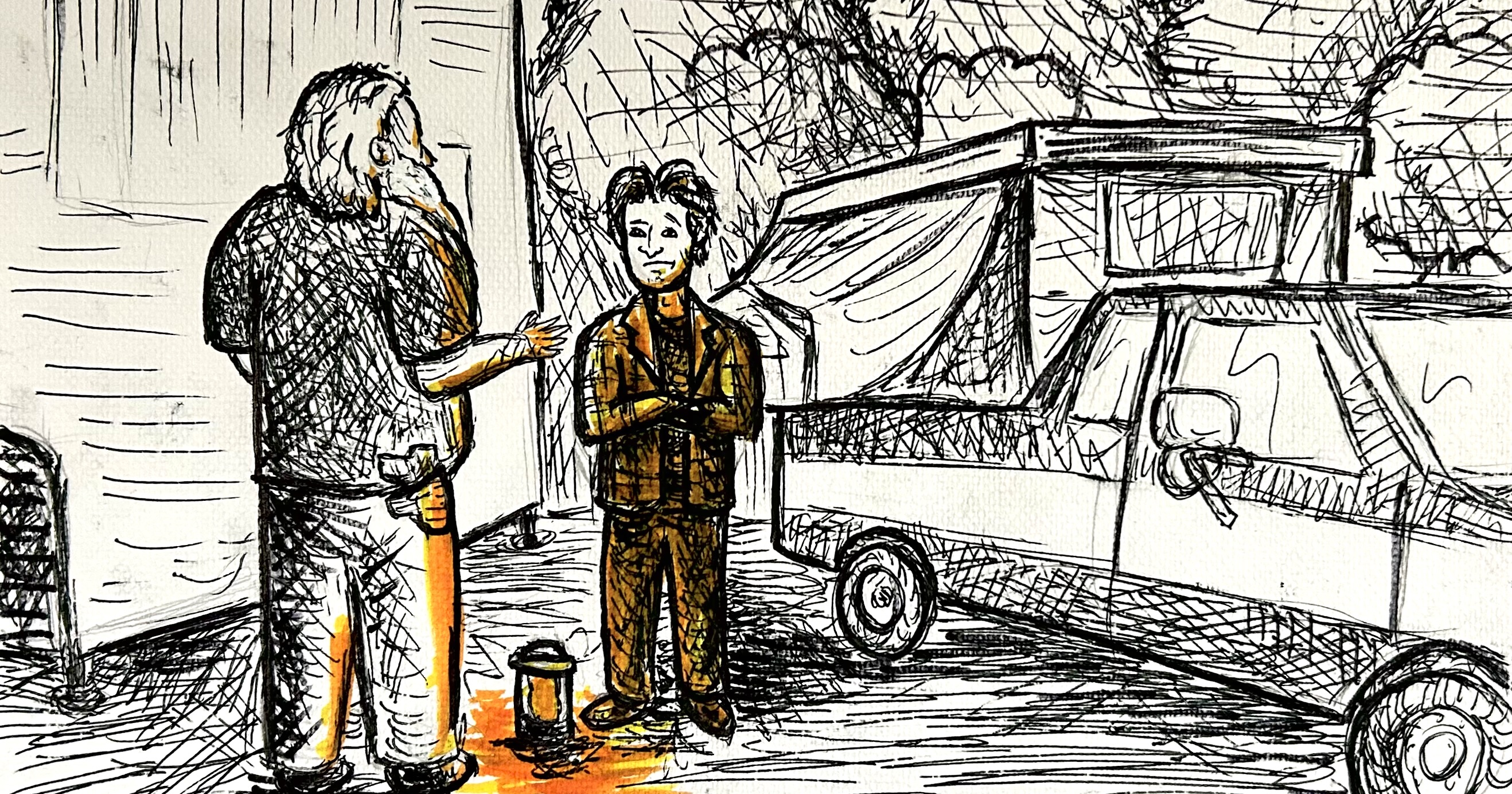
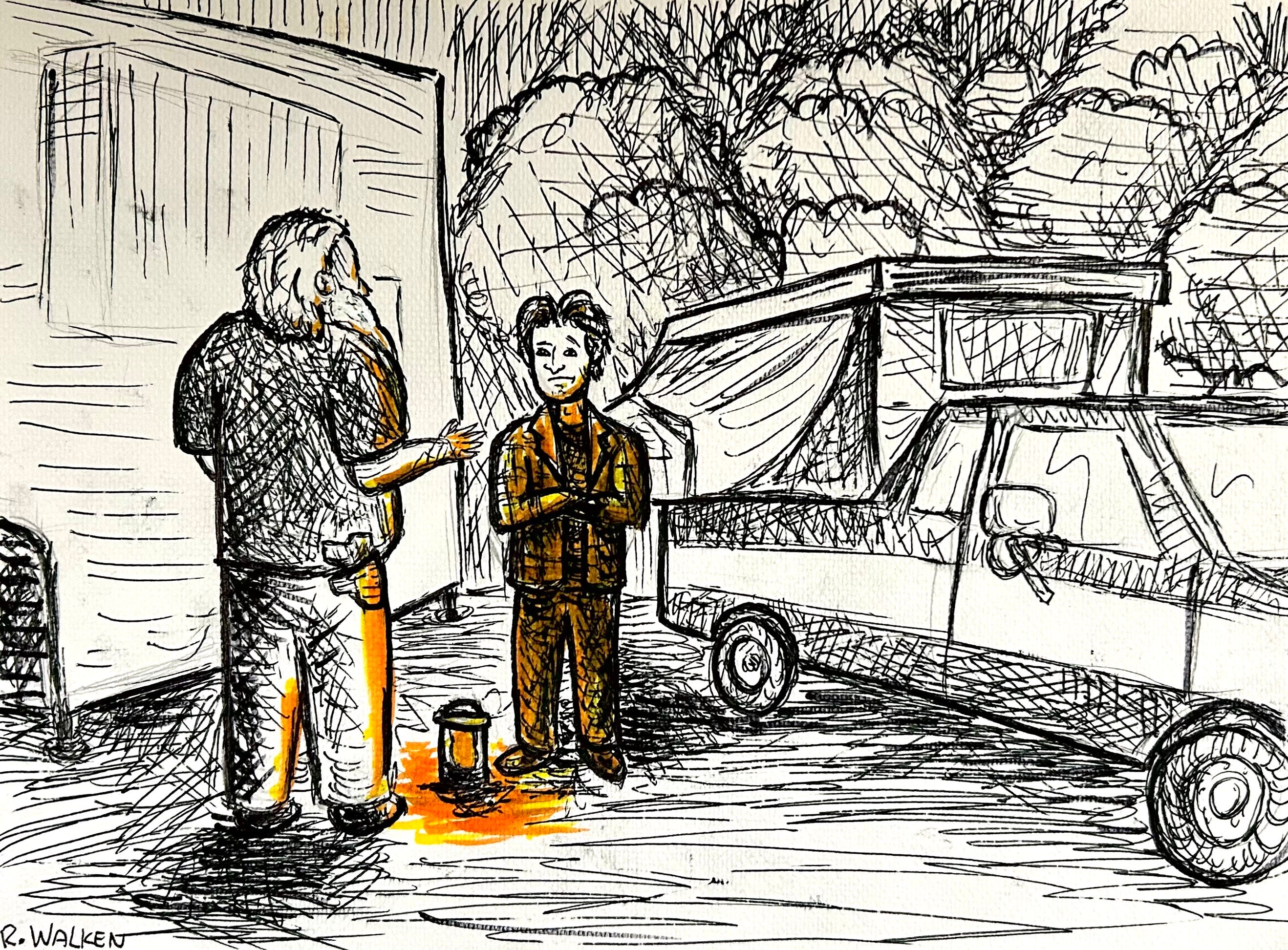
I first noticed the man when I pulled into my campsite in the Arkansas Ozarks. He was at the next site over, maybe fifty meters away: tall, early 60s, deeply tanned, with a well-kept white beard. He wore a black T-shirt and blue jeans. He had a handgun holstered at his hip.
Two teenage girls were playing on scooters in the road between our sites. The brunette was his daughter. The blonde was her friend.
I nodded as I pulled in, trying to be friendly and disarming, then went about setting up the truck.
Later, I was at the spigot on my campsite, wringing out two rags when he wandered over.
“When did you—when did you get the thing?”
“This here?” I pointed at my truck.
He nodded.
“This summer. I wanted to do a big road trip across the United States.”
He had also gotten his rig that summer: a beautiful but older forty-foot trailer. He had just taken the whole family to Noah’s Ark in Kentucky on their first outing.
“If you ever get the chance, you gotta go see it,” he said.
The sun was still up, but setting. From where I stood, I could read his shirt. It was an American flag made of redaction bars—black lines through white text. What survived said, “Trust what your government says.”
“How’d you get it?” he asked, meaning my truck again.
“What do you mean?”
“The finance. How’d you finance it?”
I told him about my life. I told him how I had run a landscaping company a few years back. I told him about my time teaching in Minneapolis, New York, and Kyiv. We traded names. His was Ryan.
The girls carved past us on their scooters and back up the street. Ryan told me about his service. He had run away from home at fourteen and enlisted young. He’d done a stint as a police officer, and then, in his late forties, had reenlisted. Before his multiple tours in the Middle East, he grew up around oil fields.
His uncle—“full-blown Indian,” Ryan said—once brought him to a dry well and told him it would fill back up one day, despite what Jimmy Carter would have you believe.
This was his opening. His politics came rushing to the surface: “Jimmy Carter wasn’t evil. He was just a pussy.” He started explaining his view on more presidents without me asking.
He said he could never forgive the Bushes. It was “one thing to fuck a thirteen- or fourteen-year-old,” he said, “and another to fuck an eight-year-old or a one-year-old.”
He pivoted from bad presidents to the Democrats and communists: “They should be lined up and shot,” he stated.
That is the order in which he said these things, as best as I can remember. It all came so fast. I absorbed each blow and each line, walking through the conversational boxing ring. I glanced down at his gun and wondered if he could tell I was someone he’d deemed worthy of being lined up and shot.
We twisted from charged topic to topic, until he interjected: “You know, I was there, at the Capitol.”
I knew he was talking about January 6, 2021. He pointed toward his trailer, just a short distance away. He said that was how close he had come to entering the building.
He started reenacting a conversation with the friend who had gone with him. He told me his friend had looked toward the doorway and said, “I think we should go up.”
“Are you stupid?” Ryan had answered.
I cut in. My hands came out in front of me, an instinctual manifestation of my disbelief, “Because it’s a federal building.”
“Exactly. It’s a federal building.”
I was surprised. His understanding of the severity of that act seemed at odds with the ridiculousness of his previous statements and calls for violence. He was not completely unhinged, but instead calculated.
The girls coasted back down the road and stopped at the edge of my campsite.
“Daddy, we’re gonna go up the street. Just out of your view.”
He stared at them.
“You do not leave my eyesight.”
They stayed, riding slow figure eights around the loop. The conversation stopped and started each time they came and went. Whenever they rolled close enough to hear us, I found myself pushing back more plainly. They never joined in, but I wanted them to hear that Ryan’s assertions could be rebutted.
When they came around again, I told Ryan I understood why he had trouble trusting the government. I did too.
“In my life, I didn’t know Reagan’s America,” I said, trying to relate. “I didn’t know Bill Clinton’s America or JFK’s America. The America I have known has been Bush, Obama, Trump, and Biden.” I’ve only ever known an America at war in the Middle East.
He looked almost sad.
“Well, you’ve only known America when we’ve had bad Democrats in office. The worst Democrats this country’s ever had.”
I asked how, after fighting in the Middle East himself, he could support Trump taking the country into another war with Iran. His answer came in two pieces that sounded like a contradiction: first, that Trump was the first real president we had ever had, and second, that Trump was assembling the cast of the Antichrist.
To Ryan, both things could be true. The Iran war was a holy war prophesied in the Bible. The conflict meant the Second Coming was close. As it had all been written down 2000 years ago, the Jews must control Israel, he argued.
Biting my tongue, I found one point of agreement. I listed the billionaires around Trump: Musk, Zuckerberg, Ellison, Kushner, and his sons. I agreed that this certainly seemed like the cast of the Antichrist. Add them up, I said, and you get to two trillion dollars.
He said yes. Something was coming. He kept calling it “the temptation.”
The scooters clicked by again. I told him about the part of the world I did not need prophecy to understand. I had taught homeless children. Children who had nothing to eat after school. Children whose parents beat them. Donald Trump had returned to office and become five billion dollars richer in the same country these kids sat.
“There was one kid I taught who didn’t have a home to go home to,” I said. “What does your worldview say to him?”
He looked at me for a second.
“Well, you’re not gonna like what I have to say.”
“No worries. Go ahead.”
He launched into predestination. God had written all of us before the universe came into being, he said. Suffering was necessary. It had been decided in advance.
I pivoted. I mentioned to Ryan how Federal agents had shot Alex Pretti, a nurse, in Minneapolis that winter. I noted that Pretti, like Ryan, had been carrying a handgun. I was starting to ask how Trump’s fulfillment of a Middle East prophecy could justify that killing when Ryan stopped me.
“Look, I lost faith in Trump once.”
I waited. I thought he might be about to talk about the money, the children, any of it.
Instead, he said he had lost faith when Trump left the January 6 defendants in prison for so long. Trump pardoned them in the end, but he let them sit for years first. That, Ryan said, screwed them up.
His wife, who couldn’t have been older than 30, had joined us by then, and the girls were sitting on the pavement. With all three listening, I tried once more.
“I appreciate your analysis,” I said, “and the points you’re making about history. But what I struggle with is the material. The everyday. I can’t see the prophecies, but I can see a child who’s homeless.”
He nodded.
“Okay, Mr. Material. Look up in the sky.”
I looked through the trees.
“You see that cloud?”
“Yeah.”
“It’s not moving.”
“Well, we can’t really see—”
“I’ve done the math.”
If the Earth were a ball spinning as fast as scientists said it does, he told me, the clouds would be moving six hundred miles per hour.
I was completely disoriented by how fast the conversation had changed. How can we find an answer to human suffering and poverty in a flat earth?
He gave me the rest of the argument. He explained that the stars stay in the same place. He enlightened me on his calculation of the ocean’s pressure, and how its coming out wrong by “a single point” disproved gravity. He recalled his missions flying Chinooks miles above Earth’s surface and how he’d never seen its curve. And remember, scientists said the Earth was supposed to be a ball of water spinning very fast.
“You could do it right now with a basketball,” he said. “Put a cup of water on it. Watch the water fall off [as you spin the ball].”
“We could go in a car,” I said, “and we could speed up. We could watch the water not move relative to us.”
He shook his head. “That is different.” Before I could ask why, he moved to another argument. That Earth exists under a dome.
Once he realized this, he said he knew the whole world was a lie. This lie, the grand lie, implicated the government, the rich, the powerful, the Democrats, the communists, and the Russians. Ryan argued that Men—he always said “men,” and I could feel him trying to appeal to my masculinity—had been given sense for a reason. “You can test these things yourself. Once you realize that—”
“Yeah,” I said, trying to understand his advancing train of conspiracy. “You realize everything’s fake. Everything’s just a game. Everybody’s just puppets.”
Night had fallen, but our conversation was not over. I switched on my light and pointed at the ground. It bounced upward and illuminated the underside of Ryan’s face.
He kept going. In Iraq, he said, the IEDs led back to Iran and then to China. The Iranians were communists. The Russians were communists. Most Democrats were communists, too. He returned more than once to the Rothschilds and, later, to a Bush ancestor who had supposedly tried to turn the United States communist. I could not tell if this was an appeal to bipartisanship.
His wife tried to end the conversation by saying the steaks were getting cold and that the dogs would eat them. “This is more important,” he said, dismissing her.
I asked one last time what he would do about homeless children.
His answer ran through predestination, a story of a friend working through his son’s death, and Revelation’s “second death” as the girls and his wife sat and listened.
We said goodnight, and the family walked back to their trailer. I climbed into my camper and, desperate to remember the details of the interaction, whispered everything I could remember into my phone.
The next day, I hiked for five hours. I came back, ate lunch, and fell asleep in the truck camper. The temperature was in the mid-nineties, and the camper—a metal roof over canvas walls—sat in direct sunlight.
I woke up with my head pounding. I wanted nothing more than to go back to sleep and stay that way. In a subconscious and sleepy panic, I went into the campground restrooms, ran cold water over myself, and started vomiting.
I had a passerby flag down a park ranger and told them I thought I had heat exhaustion. The ranger called EMS. Because I was vomiting in a campground bathroom, I also had to convince the medics that I had not taken drugs and was not trying to purge them from my system.
“Well, this is a dry county,” they said in a southern accent, “so that’s a good thing.” They agreed that if I was telling the truth and not purging a bender, I might have had heat stroke. They cooled me down, watched me for twenty or thirty minutes, and told me that we could go to the hospital but that they’d have to charge me. Currently uninsured, I passed on the ambulance ride and went on my way.
I went back to my camper to pack up. Ryan drove by in a beat-up white sedan and stopped.
“What happened?”
I told him about my run-in with the sun.
“Oh, brother. I know about that heat stroke.”
He pulled out his phone and showed me photographs from Iraq and Afghanistan. The first was a photo of a thermometer reading 120 degrees Fahrenheit. “When the heat would get bad,” he explained, “we’d sleep under our trucks.” He then showed me a photo of him with a group of Afghans. This time, the door had not opened to politics but to him, showcasing his life.
“It’s incredible,” I said. “They don’t look like they’re from Afghanistan.”
“They’re from all over the place. They’re just as diverse as our country is.” He pointed at the photo. “That’s a Russian. That guy’s a Mongolian. You’ve got to think, the Russians were there in the 1980s. There are all sorts of people there.”
Next was a photograph of a camouflage truck mangled by an IED on his last day in Iraq. Then came pictures of him when he was younger. The dates displayed on his phone included 2013, 2019, and 2020. I could see the evidence for much of Ryan’s life.
So many of the men I meet on my travels are liars. So many of them are delusional, in the midst of psychosis, or on a bender. They are not to be believed. After one evening with Ryan, I was sure that everything he had said about his life was a fabrication. There couldn’t be a veteran of the US military, a member of the police for 10 years, who could look at another American, gun on his hip, and tell them that Democrats and communists should be lined up and shot. That is the talk of a man who has either lost his mind or is angling for a civil war.
Looking at those photos on his phone, I realized I had seen proof for at least half of his biography. He had served in the Middle East and was around oil fields for part of his life. He had been a police officer. The last timestamp I saw on his phone was from 2020, so I didn’t see any photos to confirm his involvement on January 6th. I believe him anyway.
Many readers will write Ryan off as merely a conspiracy theorist. That dismissal is dangerously incorrect. Ryan is a religious man and a political ideologue. He believes in a worldview different from our own, and it is one that is serious and able to motivate a man to action.
What began on the internet as a joke—Flat Earthers—has become a gateway to religious zealotry. The community teaches people that expertise is fraud and that private revelation is a superior form of knowledge. Flat Earthers believe they are a persecuted minority in possession of the truth. From there, the cosmology becomes a political theology: God has chosen his leaders, their enemies are evil, hierarchy is sacred, and violence in defense of that hierarchy can be righteous. This, according to Ryan’s life, is the force that can take a veteran of the United States military to the steps of the Capitol for an act of sedition.
Ryan believes his utopian world should come true; he is excited that it is currently underway. It is a world arranged to suit men like him: their senses are evidence, their scripture is law, their authority is unquestioned, and the women and girls around them are subordinate. Never mind his own subordination to the wealthy as he works their oil fields or serves in their foreign wars; he can be the master of his own universe within the confines of his home and mind.
Ryan’s talk of lining up Democrats and communists and shooting them was not a joke or an eccentric aside. It was a statement about how his preferred order would be enforced. It is what is happening now as ICE pillages American communities and murders the innocent. These organizations are staffed by men like Ryan.
These politics do not remain inside a campground. They are not confined to internet forums or the people at the Capitol. Until men like Ryan are dealt with, these beliefs will continue to travel through our institutions, manifesting in our neighborhoods and throughout our nation as lawless executions, unlimited corruption, and the conversion of religious zealotry into state power.
Ryan should be taken seriously. Deadly seriously.
Post Mortem
No additional story follows. The “Post Mortem” is simply the research I did afterward and the facts as I could determine them for those interested.
Ryan said his uncle once showed him a dry oil well that would someday fill itself again, which I thought was a blatant lie. The theory is called abiotic oil: the idea that petroleum is continually produced deep inside the Earth. Soviet geologists argued for versions of it in the 1950s; Cornell astrophysicist Thomas Gold later made the American case in The Deep Hot Biosphere. A few wells have appeared to refill, but geologists generally attribute that to oil moving in from deeper reservoirs.
Ryan did not invent the motionless clouds, fixed stars, ocean pressure, or missing curve from a Chinook. Versions appear in, for example, Eric Dubay’s 200 Proofs Earth Is Not a Spinning Ball and, before that, Samuel Rowbotham’s Zetetic Astronomy: Earth Not a Globe from 1865. The dome comes from the firmament described in Genesis 1:6–8.
Ryan said the IEDs in Iraq traced back to Iran. The Pentagon has made a similar version of that claim. In 2019, it attributed 603 American deaths in Iraq to Iran-backed militias.
He said Trump had left the January 6 defendants in prison for years before pardoning them. On January 20, 2025, Trump granted clemency to more than 1,500 people charged in connection with the Capitol attack, commuting fourteen sentences and pardoning the rest. Some had been incarcerated for nearly four years.
I told Ryan the men around Trump were worth about two trillion dollars. Elon Musk briefly became the world’s first trillionaire on June 12, 2026, when SpaceX began trading on the Nasdaq. On July 16, Forbes listed Mark Zuckerberg at $233.5 billion and Larry Ellison at $174.5 billion. The total changes with the market daily and depends on who you include.
The holy war Ryan saw in Iran was Ezekiel 38, in which Gog gathers nations against Israel in the latter years. The predestination he used to explain suffering appears in Ephesians 1:4–5. The “second death” he offered at the end comes from Revelation 20:14.
One note on how I wrote this: I returned to my camper immediately after our conversation and whispered everything I could remember into a dozen voice memos, ranging from 1 to 10 minutes each. Quotation marks mean I remember the exact or near-exact words. Memory is never perfect, and this account is filtered through my recollection and point of view. I have tried to be as accurate as possible. I have also changed his name and did my best to avoid any dramatization.
LARPing America is a series of dispatches from a summer spent living out of a 1996 Ford and a 1977 camper. Previously: I Was Looking for WiFi. I Found the Town Trump Took Cell Service From Instead. Website: LarpingAmerica.com